The World It Brings to Life
There are days when the wind does not simply move through the world. It comes looking for you.
I remember being at home on windy summer days and recognizing its invitation almost immediately. It would tap against the windows, stir the trees outside, and send that unmistakable rushing sound through the leaves.
I would put on my little hat with the cherries on it and go outdoors for no other reason than to meet the wind.
I was not going anywhere. There was no errand, destination, or practical purpose waiting beyond the door. I wanted only to feel the wind against my face and breathe the air it was bringing.
The cherry hat was apparently essential equipment for this important appointment.
Even then, I understood that the air arriving with the wind was never quite the same as the air that had been there before. It seemed fresher and wider, touched by places beyond the streets and buildings around me. I would lift my face toward it and breathe deeply, as though the wind had traveled a great distance to bring me something personally.
Perhaps that is why I have never experienced wind merely as weather.
It was a presence I went outside to meet.
In the city, it often seemed to come and ask whether I was ready to play. It reminded me of an older friend from the Black Sea shoreline, although I could not always recognize it by smell.
The city wind did not necessarily carry salt, wet stone, seaweed, or the unmistakable breath of the sea. But I knew it by its voice.
In summer, especially when it moved through poplars and birches, it sounded familiar. Their leaves trembled, flickered, and rushed together with the same bright restlessness I remembered from my grandparents’ seaside town, which was also blessed with poplars and birches in abundance.
The landscapes were different, but the sound created a passage between them.
For a moment, the city trees could bring the shoreline back to me. The wind no longer needed to smell of the sea to remind me where it had once found me.
It only had to enter the leaves.
A Paradise in the City
In the capital, the wind had another place where it always knew how to find me.
Outside the apartment of my paternal grandparents stood two immensely tall poplar trees. They rose along the entire side of the building where the two bedrooms and the long balcony were situated, shading the windows and filling nearly every view with leaves.
Cuckoos called from their branches, and many other birds nested there, so the apartment never felt entirely separated from the living world outside it.
These were the grandparents with whom I practically grew up. I was exceptionally close to both of them, and my Italian grandmother was one of those indispensable people around whom an entire family seems to arrange itself. (Needless to say, she taught everyone Italian, more or less—even those who may or may not have wanted to learn it.)
Even now, I can recall her advice, her jokes, her voice, and the certainty of her presence with extraordinary clarity.
She loved Caruso.
One of her favorite arias was Verdi’s “La donna è mobile” from Rigoletto. Only now do I realize how naturally it belonged to that summer world: qual piuma al vento—like a feather in the wind. Caruso’s voice moved through her immaculate home while thousands of poplar leaves trembled, turned, and flashed beyond the windows, as though the music and the trees had always understood one another.
She also sang the Neapolitan canzonetta “Santa Lucia,” and she taught me to sing it with her, word for word. I loved it so much that I learned its guitar accompaniment as well, so I could play while I sang.
So many years have passed, yet I still remember every word. I have the feeling that if someone placed a guitar in my hands, my fingers might begin to remember the accompaniment too.
Only now, while writing about wind, do I hear how perfectly one of its lines belonged to that summer world: Placida è l’onda, prospero è il vento—calm is the wave; fair is the wind. Long before I understood what the sea and the wind would come to mean in my life, my grandmother had already taught me to carry both in song.
She was extraordinarily neat and hardworking, artistically inclined and skilled, and deeply devoted to her home. Everything around her seemed ordered, polished, and almost crystalline in its perfection. She loved nature with the same wholeheartedness.
Every summer, her long balcony became a small garden. Plants occupied corners, shelves, pots, and every space she could persuade into holding something alive. There was basil, dill, cilantro, rosemary, gardenias, petunias, and many other plants whose colors and scents entered the apartment with us.
The air there could be almost intoxicating: herbs warming in the sun, flowers opening, leaves releasing their fragrance when touched, and the unmistakable green presence of the two enormous poplars just beyond the balcony.
My grandmother always prepared a place especially for me.
It had exactly enough shade and exactly enough sun—enough for me to read, listen to music, and acquire a little color, but apparently not enough to be roasted under her supervision.
She seemed to have reached a private agreement with the sun about how much of it I was permitted to receive.
I would sit there with my books and music while the breeze moved through the poplars.
That sound was unlike anything else.
The leaves did not merely rustle. Thousands of them trembled, turned, and flashed at once, creating a rushing, shimmering sound that filled the whole side of the apartment. At times it was soft and secretive. At others, it rose and surrounded the balcony until the trees seemed to be breathing directly above me.
The effect was almost narcotic.
Then, as though the scene had not already achieved an unreasonable level of perfection, fresh lemonade with mint would appear on the little table beside me, often accompanied by a spoonful of homemade apricot preserves.
I had my books. I had my music. I had enough sun, enough shade, the scent of my grandmother’s garden, birds in the branches, and the wind moving through two great poplar trees.
It was heaven.
The balcony was only part of it.
Their home also looked onto a mesmerizing inner garden, sheltered from the noise and heat of the city. Tall pine trees rose above it, and the ground around them was filled with flowers: roses, sunflowers, honeysuckle, lilac, lilies, and many others whose names I may no longer remember but whose colors and fragrance have never entirely left me.
In the hot, dusty summers of the capital, that garden felt like an oasis. The air was cooler there, quieter and fresher. The trees held the shade, the flowers softened the space, and the whole courtyard seemed protected from the harsher world beyond it.
When the wind entered the garden, it gathered every scent together.
The sweetness of honeysuckle and lilac, the green sharpness of leaves and pine, the fuller perfume of roses and lilies, the herbs on the balcony, and the warmth of flowers opened by the sun all blended in the moving air.
The fragrance did not simply reach us.
It seemed to caress our faces as it passed.
Those moments always felt too brief. However long we stayed, we wanted the air to keep moving, the flowers to keep releasing their scent, and the garden to remain exactly as it was.
It left us satisfied and longing at the same time—grateful for what we had received, yet already waiting for one more breeze.
It was a complete summer world in the middle of a great capital city: two immense poplars, birds in the branches, a balcony transformed into a garden, a cool inner courtyard filled with flowers, and grandparents whose love made every part of it feel prepared especially for me.
Perhaps that is why the sound of poplar leaves still reaches me so quickly.
I do not hear only a tree responding to the wind.
I hear bedrooms shaded in green. I hear the balcony garden. I hear birds nesting above us and my grandmother moving nearby. I remember being given a place prepared with perfect care, where I could be alone without ever feeling unattended.
The city wind reminded me of the shoreline, but it also carried something of home.
It entered the poplars, and an entire summer world came alive.
The Leaves That Reveal the Wind
Poplar and birch trees reveal the wind especially well.
Their leaves do not simply sway. They flicker.
They turn between light and shadow, flashing their paler undersides before returning to green. From a distance, an entire tree can appear to glitter, as though sunlight itself had entered the branches and begun to move.
Birch leaves are small and delicate, responding to the slightest change in the air. Poplar leaves seem to catch the light with particular enthusiasm. Thousands move at once, but never mechanically. Each follows its own small rhythm while remaining part of the larger motion of the tree.
The result is not disorder.
It is a living shimmer.
Sometimes the movement travels across the branches in waves. One part of the tree begins to tremble, and then another answers. The light moves with it. The sound follows—soft at first, then fuller, as though the trees were taking one long breath together.
It is one of the most soothing sounds I know.
A light breeze produces a whisper, a dry and private conversation above us. A stronger wind creates something closer to applause, although it does not seem directed at anyone.
When the gusts rise, the whole crown of the tree becomes an instrument. Leaves brush against one another until thousands of separate sounds merge into one great voice.
The wind is invisible, but the leaves translate it.
They give it movement.
They give it sound.
They give it light.
When the Water Answers
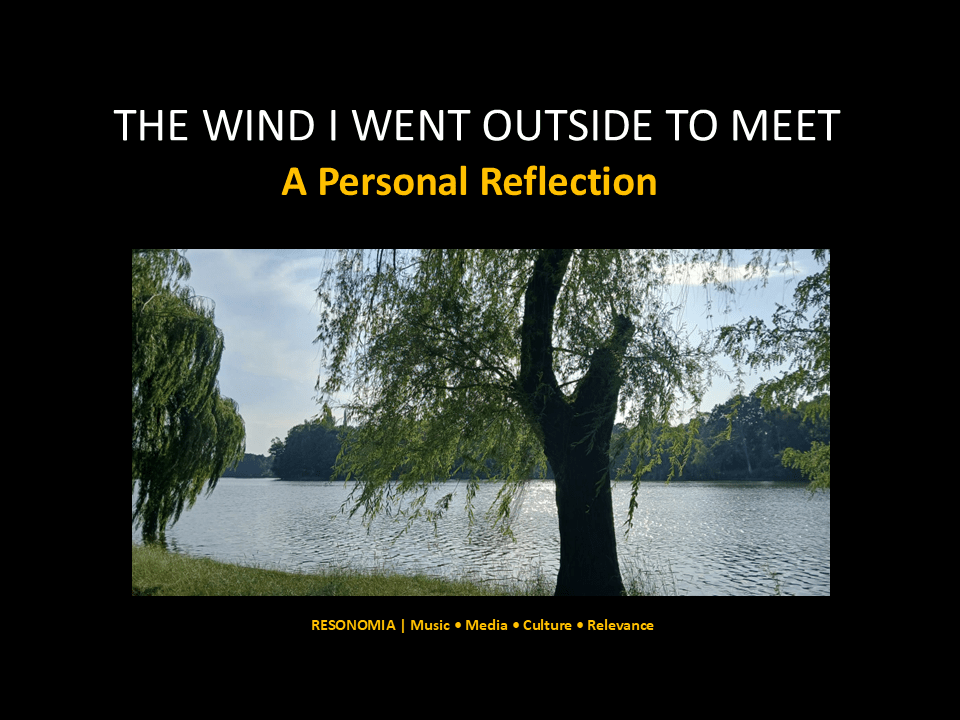
Near the lakes, the water responds to the same force in a different language.
Before the wind arrives, a lake may appear almost still, holding the sky in place. Then the reflection loosens. Small ripples appear and gather. Light breaks into fragments and scatters across the surface.
The lake begins to glitter in the same way the leaves do.
That resemblance has always fascinated me: leaves above, water below, both trembling beneath the same passing current of air.
The poplars and birches catch the sunlight in countless flashes, while the lake answers with flashes of its own.
For a moment, the trees and water seem to be made from the same material.
Then the waves begin.
On a lake, they may not possess the dramatic force of the sea, but they have their own restless beauty. They form where moments earlier there had been only a smooth surface. They travel in lines, gathering and releasing energy, one following another toward the shore.
The wind moves across the water, and the water remembers its direction.
Sometimes the waves are small enough to resemble wrinkles moving across silk. At other times they rise more clearly, darkening on one side and brightening on the other. Their crests catch the light. They approach, break softly, disappear, and are replaced almost immediately by the next.
Watching them, I feel the same rhythm I hear in the trees.
The leaves turn. The waves rise.
The leaves flash. The waves glitter.
The branches bend and recover. The waves travel toward the shore and begin again.
The leaves and the waves speak the same language—one in the air, one on the water.
Perhaps this is part of what makes wind so mysterious. It does not present itself directly. It reveals itself through relationships.
We see how a tree receives it.
We see how water answers it.
We feel it moving over our arms, lifting our hair, cooling the warmth of the day. We hear it pass through places where we cannot follow: high branches, narrow spaces between buildings, grass at the edge of a lake.
The wind is everywhere, yet never still enough to possess.
The Sea’s Complicated Sense of Humor
The waves also carry me toward another wind and another body of water.
On the Black Sea shore of my childhood, I learned early that the relationship between wind, waves, currents, and water temperature was more complicated than it first appeared.
We might speak casually about a north wind, a southerly wind, or a southwesterly one, but the sea responded to more than the direction named in a forecast.
What mattered was how the wind met that particular stretch of coast—whether it approached from the land, crossed open water, or traveled along the shoreline—as well as its strength, duration, local currents, and the layers of warmer and colder water already in place.
The distance over open water across which the wind blows is known as its fetch. When the wind is strong enough and lasts long enough, a longer fetch gives it more room to transfer energy to the surface and build larger waves. A wind arriving from the land has little open water over which to build local waves near the beach, so the shoreline may look deceptively calm.
But appearance and temperature do not always agree.
Certain wind patterns can move warmer surface water away from the coast. Colder water then rises from below to replace it through a process called upwelling.
Other patterns can push surface water toward the coast, where it gathers and is forced downward through downwelling.
The exact result depends on the wind’s direction relative to the shoreline, its strength and duration, the currents already present, and the way warmer and colder layers have formed before the wind arrives.
As a child, of course, I did not know the words fetch, upwelling, downwelling, coastal convergence, or thermal stratification.
I knew only that the sea had a peculiar sense of humor.
On a calm, beautiful day, it could look perfectly innocent and inviting, then punish that optimism the moment we entered it. The water could be so cold that the first step felt less like swimming and more like receiving an official warning from nature.
On rougher days, however, when the waves appeared to have serious intentions, the water could be unexpectedly warm.
It felt like a hydrodynamic paradox: the rough sea was warm, while the calm sea was freezing.
The contradiction was only apparent.
The waves reflected the energy being transferred across the surface. The temperature reflected a more complicated history of transport and mixing—what water had moved into the shallows, and where it had come from.
The sea was not contradicting itself.
It was showing us two different consequences of the wind’s work.
The Days Everyone Else Left
There were also days when the wind became so strong that nearly everyone abandoned the beach.
The sand in that region is extraordinarily fine—beautiful when it lies quietly beneath the feet, considerably less charming when the wind decides to distribute it personally.
It entered bags, towels, clothes, ears, food, and places sand had no reasonable business discovering.
People gathered their belongings and fled toward shelter.
I stayed.
Sometimes I walked for hours along the shoreline, barefoot, with the water reaching my knees. The coast there is long and open, the kind of shore that allows you to continue walking until distance begins to lose its ordinary meaning.
The wind struck my skin with fine grains of sand. Salt gathered on my legs. My hair stopped obeying every known rule of human grooming and flew around my head with distinctly Medusa-like ambitions.
None of it mattered.
There was something extraordinary about remaining there after the beach had emptied—walking between land and water while the wind moved through everything at once.
I was not protected from it.
I was inside it.
The waves came toward the shore. The water pulled back around my feet. Sand moved across the beach in pale, restless sheets. My clothes pressed against me and then lifted again. Every breath carried salt, distance, and the unmistakable smell of the sea.
That was where I could feel and smell the wind most completely. In those moments, I felt as though I could almost touch the Divine.
At home, I had gone outside wearing my cherry hat to let it touch my face.
On the beach, there was no longer any polite introduction.
The wind arrived with all its force, and I gave up trying to remain separate from it.
For those hours, I felt almost made of the same movement.
The pier and harbor offered another way of meeting it.
I could sit there overlooking the sea for what seemed like a little while, only to discover that hours had passed. Time behaved differently when there was nothing to measure except waves, changing light, moving air, and the horizon. I could arrive depleted and leave recharged.
The sea never appeared still for long, even when I was.
Perhaps that was why I could remain there without becoming restless.
The wind was already moving enough for both of us.
The Friend Who Found Me Again
Years later, across an ocean, the wind kept finding me.
In New York, I would leave my apartment between York Avenue and First Avenue and make my way toward the walkway overlooking the FDR Drive and the East River. On hot summer evenings, when the city seemed to hold the day’s heat long after sunset, the wind there felt like a blessing.
It came freely across the river, plentiful and generous. Sometimes I sat there. Sometimes I walked or jogged for hours simply to remain inside it.
The city was never entirely quiet, but from that place its restlessness changed character. Small boats moved across the dark water carrying points of light. The Queensboro Bridge glowed nearby, with other bridges farther along the river. Above them, the stars seemed so close that I felt I could almost reach out and touch them.
I could arrive depleted and leave restored, as though the moving air had returned something the day had used up.
Farther south, in Southern Appalachia, summer offered another kind of encounter.
The humidity could turn the hottest days into an open-air oven. After rain, the pavement seemed to steam beneath the returning heat. Then a breeze would begin to move, touching the skin so gently that the whole day changed.
And sometimes it carried a scent that returned me, inexplicably, to the Black Sea shore.
There was no saltwater nearby—only an abundance of lakes, rivers, wet earth, trees, and mountain air. Yet something in that warm breeze felt almost coastal. Perhaps what I had remembered as the smell of the sea had never belonged to salt alone. Perhaps it was also water, vegetation, wet ground, heat after rain, and the particular way moving air gathered them together.
Canoeing became one way of going out to meet that breeze. On genuinely windy days, the canoes were not allowed onto the water, so these were gentler encounters: warm air moving over the lake, the paddle entering and leaving the surface, and the little boat carrying me into the middle of it all.
Once, while I was out there in the middle of the water, a large yacht approached. A cheerful woman came to the edge and called out:
“Would you like some big waves?”
I laughed so hard, and everyone aboard laughed too. We all understood the joke. No one sitting in a small canoe wants the wake of a large yacht arriving at full force.
But the joke also revealed something I came to recognize as Southern courtesy. The larger boats slowed and waited for us to pass before accelerating again. The bigger the vessel, the more careful its people often seemed to become around those of us occupying considerably less water.
These were different landscapes and different waters: the Black Sea, the East River, and the lakes and rivers of Southern Appalachia. The wind did not sound, smell, or feel exactly the same in any of them.
But the invitation was unmistakable.
It had crossed into another chapter of my life without losing its voice.
The Wind That Came When He Left
But one wind remains unlike any other.
On July 28, 2021, my father died. It had been a warm, still summer afternoon, with no storm and no unusual wind that I knew of. He died in the afternoon, and for a while the day remained exactly what it had been: quiet, hot, almost ordinary.
It took some time before the mortuary team could come for him. When the van carrying him finally pulled away from the front of our building (and I felt like a piece of me was taken away along with him, too), a violent wind rose without warning.
It slammed open windows throughout the building, broke branches from the trees, and turned that calm afternoon into a storm unlike any we had experienced there before.
Even in our grief, we found ourselves joking that perhaps it was my father’s spirit making trouble one more time—that he was not quite ready to say goodbye, and certainly not prepared to leave quietly.
Now, as I finish this essay, July 28 has arrived with an official warning for strong winds where I live—five years to the day after his death.
I do not claim to know what such coincidences mean. But some dates seem to return carrying their own weather.
Perhaps that is why, after all these years, I still feel compelled to go outside and meet the wind.
Not to capture it or understand it completely, but simply to be present as it passes.
Inside, the world can become fixed. Walls hold everything in place. Objects remain where we left them. Time divides itself into tasks, messages, plans, and obligations.
Outside, the wind reminds us that nothing is entirely still.
Even on an ordinary summer day, the world is moving.
Leaves are turning their pale undersides toward the sun. Waves are being born in the middle of a lake. Light is breaking and reassembling across the water. Branches are drawing temporary shapes against the sky. Flowers are releasing their scent into air that will carry it somewhere else.
None of it lasts.
The exact movement of one tree will never happen again in precisely the same way. The wave that reaches the shore disappears as soon as it arrives. The fragrance changes before we have finished recognizing every part of it. The light shifts while we are still looking.
And yet there is no sadness in that disappearance.
There is repetition, but not sameness.
Another gust comes. Another part of the tree begins to flicker. Another wave forms. Another fragrance rises from the garden.
The world continues without becoming predictable.
Perhaps this is what I have always gone outside to find: not silence, exactly, but a kind of peace that includes movement.
The wind does not calm everything by making it still. It creates calm by allowing everything to move naturally.
The trees do not resist every gust. The water does not try to preserve its perfect reflection. The flowers do not keep their fragrance to themselves.
They receive the wind and become more fully visible through it.
A smooth lake may reflect the sky more clearly, but a wind-touched lake creates light of its own. A still tree may show us its shape, but a tree in motion shows us its life.
There are days when I need that reminder.
Not every disturbance is destruction. Not every loss of stillness means that something has gone wrong. Sometimes movement is how the world breathes.
Sometimes the surface must break into a thousand pieces before it can begin to glitter.
The wind cools, refreshes, clears, scatters, lifts, unsettles, and awakens. It moves through the same place and changes everything without taking its identity away.
The trees remain trees.
The lake remains the lake.
The river remains the river.
The sea remains the sea.
But for a little while, we see them differently.
We see the leaves not as a green background, but as thousands of individual surfaces responding to light. We see water not as a fixed body contained by its shore, but as an immense moving skin. We notice scents the still air had kept separate. We hear details that silence had hidden.
And perhaps we notice ourselves differently too.
We remember that attention can transform an ordinary afternoon. Wonder does not always require distance, travel, or spectacle.
Sometimes it is waiting in the trees we have passed hundreds of times, in the lake we thought we already knew, in a balcony garden prepared by someone who loved us, or in a sound entering through an open window.
Sometimes the world calls us without words.
The leaves begin first.
The water answers.
And before we fully understand why, we find ourselves outside—beneath the branches, beside a lake, on a balcony shaded by two great poplars, along the East River, in a canoe on an Appalachian lake, on the pier, or walking barefoot through the edge of the sea—feeling the air move around us.
We cannot see the wind itself.
But we recognize it in everything that comes alive as it passes.
The Wind I Went Outside to Meet – A Personal Reflection
RESONOMIA | Music • Media • Culture • Relevance
Exploring the voices, ideas and stories that continue to resonate long after the moment has passed.
More voices. More stories. More reflections to come.
Featured image: Original Resonomia photograph. Resonomia editorial design.
 Resonomia
Join the Resonance where ideas resonate and conversations begin. Resonomia explores the intersections of music, media, culture and society, seeking not merely to understand what we experience, but why it continues to resonate. Whether you agree, disagree, or simply wish to share a different perspective, your voice is always welcome. Share your thoughts, questions, and reflections. Every conversation adds another layer to the story.