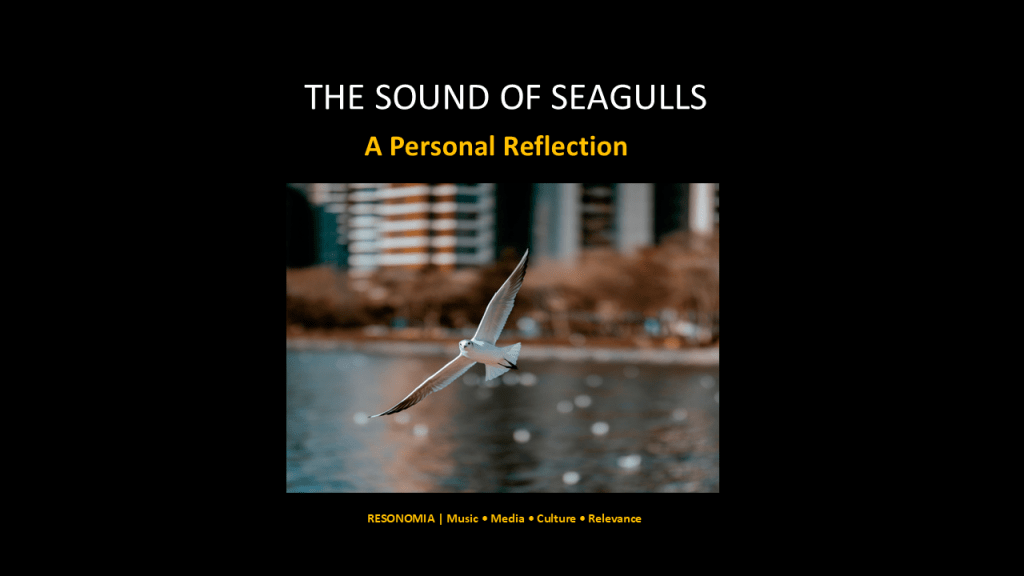
When the Sea Enters the City
I grew up in a capital city, nowhere near the sea, waking to the sound of seagulls.
This was not as improbable as it may seem. I was fortunate enough to be born and raised in one of the most beautiful neighborhoods in the city—possibly the most beautiful, although I admit that I may not be an entirely neutral judge. It is a part of the city filled with parks, peaceful streets, old trees, and lakes. Water birds have always belonged to it: some floating with great composure, others flying overhead and commenting loudly on the day.
And for as long as I can remember, there were gulls.
My neighborhood was not necessarily the only part of this enormous city where the gulls lived. With other lakes, reservoirs, and a river crossing the capital, they may well have had other familiar territories. But these were the gulls I knew—the ones whose calls entered my mornings, crossed the lakes near my home, and became part of the neighborhood’s identity.
Their calls were among the sounds of morning. Cheerful, conversational, and occasionally ridiculous, they seemed to be laughing above the lakes, exchanging news, repeating gossip, or continuing arguments that had apparently begun before sunrise.
They were not the naughty seaside kind.
They did not steal sandwiches from distracted tourists, terrorize outdoor cafés, or patrol the promenade in search of unattended French fries. The gulls of my neighborhood were respectable city residents. They minded their own business. They had lakes, islands, trees, and plenty of air in which to conduct their conversations.
They were noisy while flying and completely silent on the ground.
Once they landed, they became elegant, self-possessed pedestrians. They walked carefully, looking both dignified and slightly on guard, as though crossing the city required a more formal version of themselves. In the air, they could laugh. On the pavement, they paid attention.
Their voices gave the neighborhood something the rest of the capital often lacked, especially in summer: space.
When the city became crowded, polluted, and stuffy, the gulls gave it a coastline.
Their cries carried water into the streets. They brought open sky between apartment buildings and made an inland neighborhood sound briefly like a beach resort. Even during the colder seasons, one call could introduce the possibility of summer.
It always made me want to go to the sea.
That desire was immediate and unavoidable, but because I could not leave for the coast every time a gull expressed an opinion outside my window, the sound itself became a consolation. It did not replace the sea. It simply brought it close enough to breathe.
And it was never just any sea.
My mother was born and raised in the seaside town where my grandparents lived. She practiced medicine there for many years, and her family belonged there. My grandparents’ home became my summer home and playground. That town held long holidays, childhood freedom, familiar streets, and air with a scent I have never found anywhere else.
I have been fortunate enough to see many beautiful coastlines in Europe and the United States. I have admired them sincerely. But none has ever compared.
Beauty is not always an objective matter. Sometimes one coast is more beautiful because your childhood is still running along it.
For most of my life, the gulls in my neighborhood connected those two homes without making a ceremony of it. They carried the sound of my mother’s coast over the lakes of the city where we lived. They brought the seaside into ordinary mornings and made distance feel less absolute.
Over time, however, their sound began to change.
Their habitat around the lakes was seriously disturbed, and the gulls no longer seemed to know quite where to go. For a while, their calls could be heard throughout the day and far more often at night—something I did not remember from earlier years, at least not with that frequency or intensity.
Above the lakes, they had once sounded as though they were laughing.
Above concrete and pavement, they began to sound more like they were complaining.
They started nesting or resting in places where I had rarely seen them before: courtyards, sidewalks, backyards, rooftops, and the narrow spaces between buildings. On the ground, they could still look elegant, but they also seemed worried, cautious, and disoriented—especially the young ones.
One youngster appeared in our backyard and sat there quietly, looking frightened and apparently waiting for his mother. The neighbors were already considering calling the rescue team when she finally came back for him, proving that the gull family had not yet surrendered all responsibility to municipal services.
Another young gull paced at the corner of my street, repeatedly climbing onto a fence and then jumping back down. Everyone who passed worried that he would wander into the road and be hit by a car. For a while, the whole corner seemed united by the urgent concern that one inexperienced bird had absolutely no idea what he was doing.
The adult gulls also began visiting the bowls of dry food left for the backyard cats.
This was new.
The gray-backed crows had been doing it for years, and the cats had apparently accepted their right to dine. I have seen cats and crows eating side by side from separate bowls, neither party showing any interest in international conflict. The gulls joined this arrangement too.
The cats did not seem inclined to challenge them.
Perhaps size creates diplomacy. Gulls and crows were treated as fellow citizens. Pigeons, although equally fond of cat food, were not always granted the same protected status and could occasionally find themselves promoted from guests to lunch or dinner.
The gulls at the bowls were still funny. Their presence had not lost all its comedy. Yet I could not look at them without remembering that they had never needed to come there before. They once had their own business to mind. Now they seemed to be searching for alternatives.
A familiar sound can remain recognizable while no longer meaning exactly the same thing.
For a time, the gulls still brought me the sea, but their calls also carried restlessness. The birds who had once given oxygen to the neighborhood seemed unable to find enough space for themselves.
Then even those restless calls began to disappear.
Over the past week, their voices have gradually faded until entire mornings and days have passed in total silence—including the early hours when they were once at their loudest. The neighborhood has not simply become quieter. It feels as though one of its oldest living presences has been erased from the air.
That silence is difficult to accept because it follows the disruption of one of their long-established habitats. Too often, there appears to be no coherent planning at all—no serious ecological assessment, no strategy, no contingency plan, and no meaningful consultation with people who understand the environment being altered. Action comes first: rushed, fragmented, and careless. The damage follows. Then responsibility is passed from one authority to another while no one fully accepts what has been done.
In the end, it is the city, its neighborhoods, its habitats, and the creatures that depend on them that pay the price—sometimes irreversibly—while short-term interests and financial gains take priority over professional judgment and the public good. Expertise would help, certainly. But even in its absence, ordinary common sense, care, and respect for living places should be enough to prevent some of this destruction.
The gulls once belonged so naturally to the neighborhood that their presence required no explanation. Now their absence has become another way of hearing what has been lost.
And yet there is one gull’s call I will always remember differently.
My mother is buried on the coast, in her family’s resting place. It was her wish to be taken there from the capital, where we lived. During her illness, she had longed to return one more time, but her condition made the journey impossible.
Her burial took place in late October, when the coast is usually chilly, cloudy, rainy, or windswept.
That day was magnificent.
The sun was bright. It was warm enough for short sleeves. There was only a hint of a sea breeze—the kind of day my mother loved and had wanted so much to experience there once more.
During the most important part of the religious ceremony, a gull came close and began to call.
It was not a short call. It was not a sad one. It was loud, insistent, and so determined to be heard that it nearly interrupted the ceremony.
I had to look up.
Through all the tears and sadness, I smiled.
A warm gust of wind passed over us and almost took my cap with it. For a moment, I felt something I still cannot explain: relief, warmth, and the unmistakable presence of personality.
My mother’s personality, through and through.
She had always had very strong opinions, and she had never needed much help making them heard.
I do not know what the gull meant. It may have meant nothing beyond the ordinary business of being a gull on an unusually beautiful October day. But I know that the weather was exactly as my mother would have wanted it. I know that the wind came from the sea she had missed. And I know that the call demanded our attention in exactly the way she would have done.
Since then, the sound of seagulls has carried even more.
It still contains childhood, summer holidays, my grandparents’ home, and the Black Sea air. It still makes a crowded city feel briefly more spacious. It still awakens the wish to leave everything and go to the coast.
But sometimes, when a gull calls above the buildings, the sea does not merely enter the city.
For a moment, something of home returns with it.
The Sound of Seagulls/When the Sea Enters the City – A Personal Reflection
RESONOMIA | Music • Media • Culture • Relevance
Exploring the voices, ideas and stories that continue to resonate long after the moment has passed.
More voices. More stories. More reflections to come.
Featured image: Photo by Muhammed Eratilgan on Pexels. Resonomia editorial design.
 Resonomia
Join the Resonance where ideas resonate and conversations begin. Resonomia explores the intersections of music, media, culture and society, seeking not merely to understand what we experience, but why it continues to resonate. Whether you agree, disagree, or simply wish to share a different perspective, your voice is always welcome. Share your thoughts, questions, and reflections. Every conversation adds another layer to the story.