Before taste, before memory, before choice, some voices are already listening for us.
Before I understood language, one particular song could make me cry.
My mother told me the story many times. I was still a baby, lying in my cradle, when Andy Williams’ Love Story began to play. Almost from the first notes, I would start crying.
Every time.
Not after the lyrics.
Not after the chorus.
Before I could possibly have understood what the song was about.
I knew nothing of love, loss or longing. I could not understand a single word. Yet something in those first notes was already reaching me.
Neither my mother nor I ever found an explanation for it.
Perhaps there was something in the melody that my small, unformed world already recognized. Perhaps it was the tenderness in the voice, or the sadness carried beneath it. Perhaps music can sometimes reach a place in us that exists before language – and perhaps that place never entirely disappears.
A little later, music stopped me in another way.
My mother remembered the moment clearly, although I can no longer remember with certainty which Beethoven piece she said was playing – perhaps the Fourth Piano Concerto, perhaps the Moonlight Sonata. What remained was not the title of the piece, but what she saw when she entered the room.
I was in my baby walker, as close to the television as I could get, my face almost pressed against the screen. My eyes were wide open, barely blinking. My mouth was open. I was shifting from one small foot to the other, completely mesmerized by what I was hearing.
She had come in from the kitchen and stopped, perplexed by the intensity of my attention.
She tried to move me away, but I would not leave. Nothing could persuade me from that spot until the performance ended.
I do not remember the broadcast itself.
I remember it because she remembered it for me.
The Andy Williams song had reached me through tears. Beethoven reached me through wonder – through a kind of concentration so complete that the rest of the room seemed to disappear.
Then came Salvatore Adamo.
I loved his voice so much that I apparently insisted on keeping his photograph beside my bed.
Children do not compare discographies or debate vocal technique. They do not yet know what makes a voice elegant, distinctive or emotionally persuasive. They do not understand reputation, genre, cultural importance or artistic legacy.
They simply know when something reaches them.
And perhaps that is where our musical lives truly begin – not when we buy our first record, attend our first concert or consciously choose a favorite artist, but much earlier, when a voice enters the room and finds us before we know enough to go looking for it.
We often speak of discovering music as though it begins with an act of independence.
We remember the first album we bought with our own money. The first song we played repeatedly behind a closed bedroom door. The first artist who felt entirely ours rather than inherited from the adults around us. The first concert, the first poster, the first moment when music became part of how we understood ourselves.
Those discoveries matter. They are the moments when taste becomes identity.
But they are not always the beginning.
Long before we buy our first album or create our first playlist, someone else is quietly choosing the soundtrack of our childhood.
A parent puts on a record. A song plays on the radio while something ordinary is happening in another room. Music travels from the television while a child plays nearby. A familiar voice returns often enough that it becomes part of the house itself – like the light through a window, the sound of dishes from the kitchen or the rhythm of footsteps in a hallway.
No one announces that an introduction is taking place.
The adults may simply be listening to what they love. They may not realize that someone smaller is listening too, absorbing not only the melody but the atmosphere surrounding it.
Our first music teachers rarely know they are teaching us.
They do not explain why a song matters. They place it within the ordinary texture of life, where it becomes inseparable from safety, curiosity, family, solitude or home.
Years later, we may hear the same voice and feel something move before memory has even supplied the reason.
The body recognizes what the mind has not yet named.
Perhaps that is why some early voices remain with us even after our tastes expand far beyond them. We may discover louder music, stranger music, more difficult music. We may cross genres, languages, countries and decades. We may become devoted to artists our families never played and build musical identities that appear entirely our own.
Yet the earliest voices do not always disappear.
They remain beneath the later discoveries – not as limitations, but as foundations.
They may have taught us, long before we could explain it, that a voice could contain sadness without frightening us. That music could command complete attention. That a singer could feel familiar without being personally known. That sound could create attachment before we understood the idea of attachment itself.
The child crying in a cradle was not choosing a song.
The toddler pressed against the television was not choosing Beethoven.
The little girl who wanted Adamo’s photograph beside her bed was not constructing a musical identity.
And yet, something was already beginning.
Perhaps our relationship with music does not begin with preference at all. Perhaps it begins with recognition – with the strange certainty that something coming from outside us has touched something already waiting within.
Much later, we call it taste.
We call it memory.
We call it the soundtrack of our lives.
But before any of those words existed, there was simply a voice entering a room, a melody beginning, and a child responding.
Before I knew what music was, something in me was already listening.
And before I learned how to find the voices that would shape my life, some of them had already found me.
The Voices That Found Us First – A Personal Reflection
More voices. More stories. More reflections to come.
RESONOMIA | Music • Media • Culture • Relevance
Exploring the voices, ideas and stories that continue to resonate long after the moment has passed
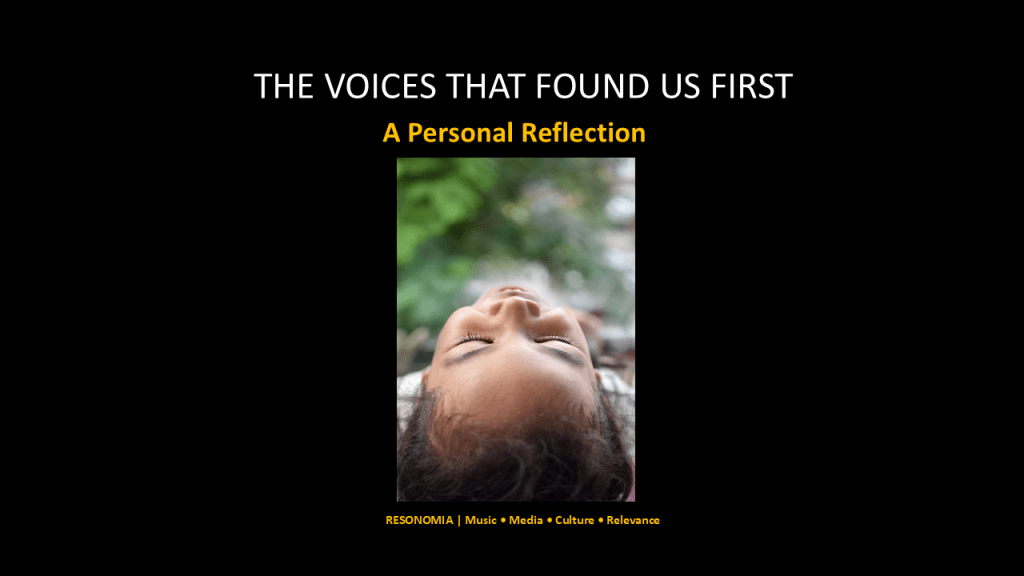
Featured image: Photo by dnilrothanak on Pixabay. Resonomia editorial design.
 Resonomia
Join the Resonance where ideas resonate and conversations begin. Resonomia explores the intersections of music, media, culture and society, seeking not merely to understand what we experience, but why it continues to resonate. Whether you agree, disagree, or simply wish to share a different perspective, your voice is always welcome. Share your thoughts, questions, and reflections. Every conversation adds another layer to the story.