There are songs we discover because we are searching for music – and then there are songs that seem to discover us. They arrive at exactly the right moment – or perhaps the most vulnerable one – and attach themselves to something already living inside us.
A memory.
A person.
A distance we have learned to carry.
A place we still call home, even after years of living somewhere else.
I spent a long period of my life away from home – first to study, then to work. Leaving had been my decision. It was part of growing, building a life and discovering who I might become beyond the world I already knew. But choosing to leave does not make distance easier.
You can be excited about the life ahead of you and still miss the one behind you. You can become independent and remain deeply connected to the people who first made you feel safe. You can build another home without ever completely loosening the invisible thread leading back to the first one.
During those years, certain songs began to mean more to me than the circumstances in which they had originally been written. They became connected to my own life. Perhaps the clearest example was Ozzy Osbourne’s “Mama, I’m Coming Home.”
There is something especially moving about hearing one of rock’s heaviest and most recognizable voices sing about returning. The darkness, theatricality and enormous sound seem to fall away, revealing something far more vulnerable beneath them.
But I was not thinking about Ozzy’s life when I listened to it.
I was thinking about mine.
To me, the song was about my mother.
She possessed the same fiery temperament the song seemed to recognize – the kind of forceful presence that could be challenging, overwhelming and impossible to ignore. But she was also endlessly helpful, practical and fiercely committed to finding a solution whenever one was needed. While I was living abroad, there were times when I could not simply call her or see her on a screen whenever I wanted. Yet even then, I carried her with me.
I would picture her face and ask myself:
What would she advise me to do now?
What would she notice that I was overlooking?
How would she help me find my way through this?
Her presence had become a form of inner guidance. Distance had not silenced her voice. In some ways, it had made me listen to it more carefully. That is why “Mama, I’m Coming Home” felt so uncannily close to my own experience. It held the contradictions of our relationship: fire and tenderness, difficulty and devotion, distance and an attachment that remained unbroken. However far away I was, some part of me was always turning back toward her.
I knew the song had been written from another life.
But when I heard it, it spoke in the language of my own.
That is one of music’s most extraordinary abilities.
A song begins with someone else’s experience. It may be written about a different person, a different relationship, a different loss or return. Yet once it enters the world, it no longer belongs entirely to the circumstances that created it.
The songwriter gives a song its origin.
The performer gives it a voice.
But the listener gives it memory.
“Simple Man” carried another part of my mother with me. Whether heard in Lynyrd Skynyrd’s original or through the emotional force of Shinedown’s version, the song feels like advice being passed from a mother to her child.
Not instructions for achievement.
Not a demand for recognition.
A reminder of what matters when the noise of the world becomes too loud.
Live honestly.
Know who you are.
Do not lose yourself while trying to become someone.
My mother had expressed that same truth even more directly:
“Do not let people and circumstances change who you are.”
My mother understood the emotional side of that struggle because, as she often reminded me, she had once been a hopeless romantic too. That made her advice feel less like judgment and more like recognition. She understood the impulse to believe deeply, to trust feeling and sometimes to give more of yourself than might always be wise.
For me, the song belonged naturally to the inner conversation I continued having with her while I was away. I would ask what she considered truly important – and how she might strip away the unnecessary complications until only the essential truth remained.
Sometimes a parent’s guidance survives so completely inside us that we no longer know where their voice ends and our own begins.
We believe we are thinking independently.
And perhaps we are.
But somewhere beneath the thought is the memory of a face, a familiar tone and a lifetime of lessons absorbed long before we realized we were learning them.
“Let It Be” belongs to that same emotional territory. A mother’s voice returns when it is needed most – not necessarily with an answer to every question, but with reassurance: a presence carried through memory, a calmness that survives absence. Long after childhood ends, we continue to listen for the voices that once steadied us. Sometimes they return through dreams. Sometimes through remembered advice. Sometimes through a melody heard unexpectedly at precisely the moment when we need it.
Perhaps that is why “home is where Mom is” can feel more truthful than any definition involving walls or geography. Before home becomes an address, it is a presence.
A voice calling from another room.
A familiar hand.
The person who first teaches us what safety feels like.
Home is where someone understands the meaning of our silences.
Where our history requires no introduction.
Where, even after years away, some essential part of us remains recognizable.
Daughtry’s “Home” carried the other side of that experience for me. It expressed something difficult to explain to anyone who has never lived far from the place and people they love: the feeling that distance can expand your life while also dividing it.
You learn new streets, new customs and new ways of belonging. You become capable of navigating a world that once felt unfamiliar. You grow stronger because you must. And still, somewhere beneath all that growth, part of you continues to count the distance home.
Returning is rarely just a matter of geography. It is the moment the familiar becomes physical again: the door, the rooms, the voices, the particular way light enters a place you have known for years – and the relief of no longer having to explain where you come from. Songs about home understand that return is rarely only about arriving at an address. We return to a version of ourselves that exists most completely around the people who knew us before the rest of the world did.
John Denver’s “Take Me Home, Country Roads” carries that longing almost as a physical pull. The road itself seems to know where it is leading, toward a landscape remembered by the body. I still experience that feeling whenever I return. It does not matter whether I have been away for two hours or ten years. The moment I approach the space I recognize as mine – my neighborhood or even its familiar surroundings – something in me relaxes.
The tension leaves my body, followed by a small sigh of relief:
I’m home.
“Sweet Home Alabama” carries a similar recognition through place and identity. Sometimes home is the atmosphere that formed us – the music, language, streets, customs and contradictions of where we came from.
We may leave it.
We may criticize it.
We may spend years defining ourselves beyond it.
And still, proximity can make the body recognize belonging before the mind finds the words.
A few notes can bring the entire landscape rushing back.
Pink Floyd’s “Time” offers another form of return. After its urgency and awareness of passing years comes the sudden relief of home again: shelter, familiarity and the warmth of briefly stepping outside time’s demands. Perhaps home appears so often in music because it is one of the few words capable of holding a building, a person, a country, a childhood and a state of mind at once.
Sometimes, however, home is defined not by return, but by absence. Avenged Sevenfold’s “So Far Away” carries that ache. A song may have emerged from one particular grief, but grief recognizes itself across different lives. Distance can be measured in miles, years or silence. It can also exist in the finality of someone no longer being where they once were. What matters to the listener is not whether every biographical detail matches, but the moment the music opens a door to something we have felt and perhaps never expressed so precisely.
The people we love do not occupy only physical space. They become part of the emotional structure of the world around us.
When they are far away, the world feels altered.
When they are gone, its geography changes completely.
But mothers are not the only people who build our first emotional home. Tori Amos’s “Winter” has always carried me toward my father. Its movement from childhood protection toward the difficult knowledge that we must eventually grow beyond it felt uncannily close to my own relationship with him.
My father was my first playmate. He was also the person who first placed me on ice skates and taught me to trust the unfamiliar surface beneath my feet.
One winter, when I had forgotten my gloves at home, he gave me his own. They were enormous on my small hands, but they kept me warm as I moved across the ice. I still remember the feeling of my hands disappearing inside his oversized gloves, protected by something that belonged to him. It is such a small memory. And yet it seems to contain an entire relationship.
But the deepest connection I feel with “Winter” lies in something less visible. My father had absolute confidence not only in who I was, but in how I was. Long before I fully understood it myself, he seemed to recognize something steady beneath the surface – deep, grounded waters, and a nature he trusted to be honest, discreet, kind and fundamentally good.
From a surprisingly early age, he confided things in me that he would not share with others. What surprised him was not only that I understood their importance, but that I seemed to understand instinctively when something needed to remain private. He trusted both my judgment and my heart. That trust became one of the foundations of who I was growing into. It is a powerful thing for a child to be seen that clearly by a parent – not merely protected, but known.
A father beside his daughter.
Teaching her how to move forward.
Protecting her when she is unprepared.
Trusting the person she is becoming before she has learned to trust herself.
That is what “Winter” has always awakened in me: not only the tenderness of childhood, but the lasting strength of having once been seen, understood and believed in so completely. It also carries the sadness and beauty of knowing that childhood cannot remain unchanged.
As children, we believe our parents will always stand exactly where we left them.
Then time begins its work.
We grow older.
They grow older.
The hands that once held ours cannot accompany us forever in the same way. The protection that seemed permanent gradually becomes memory, inheritance and an inner voice we must learn to carry for ourselves.
But perhaps growing up does not mean leaving that love behind. Perhaps it means learning to move through the world with what it gave us.
My father may have been the one who first steadied me on the ice, but eventually I had to find my own balance. And still, somewhere within that balance, I carry the warmth of his gloves.
A mother may teach us what home feels like.
A father may teach us how to walk away from it without losing our way back.
And sometimes a song becomes the place where those lessons remain audible.
This is why the original meaning of a song, while important, is never its only meaning. Authorial intention tells us where the song began. It does not determine every place the song may eventually reach. Listeners bring their own histories – their mothers and fathers, their distances, their departures and returns. A song written for one person can become attached to someone entirely different. A lyric born from one loss can give shape to another. A voice associated with darkness or power can accompany us through our most tender memories.
This does not betray the song.
It completes its journey.
Perhaps the songs that stay with us longest are not always the ones that describe our lives literally. They are the ones that leave enough room for us to enter. We recognize something inside them. Then slowly, over years of listening, they become inseparable from our own emotional history.
“Mama, I’m Coming Home” became part of the road leading back to my mother.
“Simple Man” carried her guidance.
“Let It Be” held the idea of a mother’s voice returning when it was most needed.
“Home” expressed the distance between the life I had built and the place where I still belonged.
“Take Me Home, Country Roads” carried the physical pull of return.
“Sweet Home Alabama” turned place into identity.
“Time” held the relief of arriving.
“So Far Away” gave sound to separation and absence.
And “Winter” became inseparable from my father, the ice beneath my feet, his trust in the person I was becoming and the warmth of his oversized gloves.
None of those songs was written about my life. And yet, in some essential way, they became true within it. That may be the real mystery of resonance. Music does not ask whether our memories match the songwriter’s intentions. It simply finds the places where our own stories are waiting.
Perhaps home is not merely the place we left, the house we remember or the destination to which we return. Perhaps home is also made of voices.
The voices of the people who first knew us.
The voices we miss when we are far away.
The voices that remain within us after everything else has changed.
And sometimes, the voice that leads us home belongs to a singer who never knew us at all.
The Songs That Lead Us Home – A Personal Reflection
More voices. More stories. More reflections to come.
RESONOMIA | Music • Media • Culture • Relevance
Exploring the voices, ideas and stories that continue to resonate long after the moment has passed.
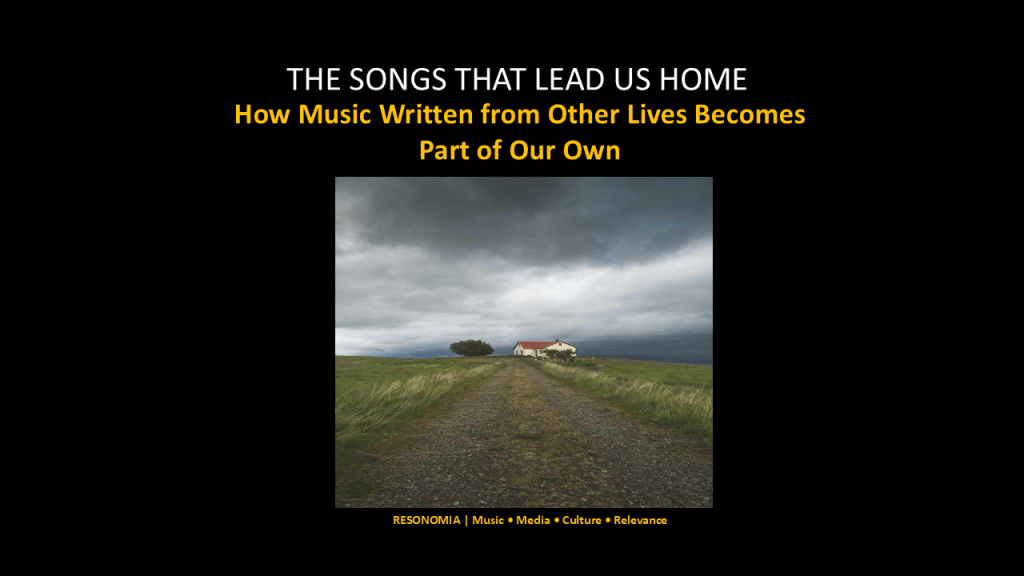
Featured image: Photo by John Thomas on Unsplash. Resonomia editorial design.
 Resonomia
Join the Resonance where ideas resonate and conversations begin. Resonomia explores the intersections of music, media, culture and society, seeking not merely to understand what we experience, but why it continues to resonate. Whether you agree, disagree, or simply wish to share a different perspective, your voice is always welcome. Share your thoughts, questions, and reflections. Every conversation adds another layer to the story.