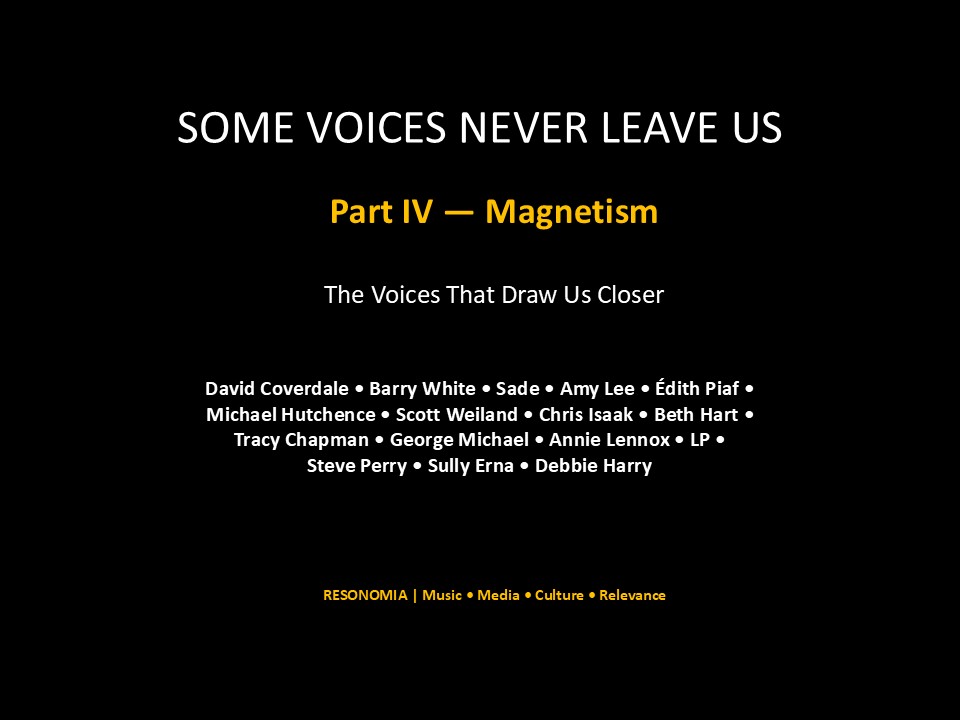
The Voices That Draw Us Closer
There are voices we admire. There are voices we recognize instantly. There are voices whose technical brilliance leaves us speechless.
And then there are the voices that seem to do something altogether different.
They draw us closer.
Not because they are louder, technically flawless or suited to some universal definition of beauty. They possess something far more elusive: a magnetic pull both subtle and unmistakable.
The kind that makes us stop listening only to the music…
…and begin listening to the person behind the voice.
It is one of music’s enduring mysteries. Why can two people hear exactly the same singer, yet only one of them feel completely captivated? Why does one voice remain with us for decades while another, equally accomplished, gradually fades from memory?
Perhaps because magnetism is not something we measure. It is something we experience. It resists rankings, ignores genres and has little interest in technical perfection. Instead, it seems to speak directly to something instinctive within us.
Perhaps it even belongs to a much older human story—one about the remarkable way we have always recognized something of one another through sound.
Whatever its origin, magnetic voices never seem to follow the same path. Some invite us closer; others surround us with mystery. Some comfort us; others leave us unsettled. Some reveal strength; others expose vulnerability.
Every magnetic voice discovers its own language.
David Coverdale’s voice feels like an invitation. Beneath its unmistakable confidence lies an unexpected warmth, as though every lyric were directed toward a single listener rather than an entire audience.
Barry White discovered something equally powerful through intimacy. His voice never seemed to demand attention. Instead, it created closeness, transforming even the largest stage into an intimate exchange.
Sade shows that magnetism can whisper. Nothing in her voice appears rushed. It simply exists with extraordinary grace, proving that serenity can draw us in every bit as powerfully as intensity.
Amy Lee draws listeners into another world altogether. Her voice carries a haunting beauty, suspended somewhere between strength and fragility, atmosphere and confession. Its magnetism feels almost ethereal, as though the emotion is arriving from a place just beyond ordinary language.
Édith Piaf possessed a magnetism rooted in emotional exposure. Her voice never seemed separated from the life behind it. Longing, heartbreak, resilience and defiance arrived together, making every song feel less like a performance than an encounter drawn directly from experience.
Then there are the voices that fascinate through mystery.
Michael Hutchence possessed an effortless presence. Relaxed, confident and completely at ease within the music, his voice never appeared to chase attention. Somehow, attention always came willingly to him.
Scott Weiland approached magnetism from another direction. There was unpredictability in his voice, a sense that anything might happen next, and that uncertainty itself became irresistible.
Chris Isaak turned longing into atmosphere. His voice could feel intimate and distant at the same time, carrying tenderness, loneliness and restraint within the same phrase. He rarely seemed to reach for the listener. Instead, he created a space the listener wanted to enter.
Other voices draw us closer through honesty.
For Beth Hart, emotional surrender itself becomes magnetic. Her performances feel like acts of trust, as though the listener has been allowed into a private truth.
Tracy Chapman demonstrates something quieter but no less powerful. Her voice never relies on ornament or spectacle. It simply speaks. And somehow, we believe every word.
Some voices attract us through confidence.
George Michael possessed a rare elegance that never asked to be admired. His voice earned our attention through restraint rather than excess, carrying sensuality, vulnerability and control with remarkable ease.
Annie Lennox commands attention differently. Strength and sensitivity coexist naturally within her voice, creating a presence that feels commanding without ever losing its emotional openness.
LP demonstrates that individuality has its own singular magnetism. There is no attempt to imitate anyone else. The voice exists exactly as it is, and that fearless authenticity becomes impossible to ignore.
Steve Perry offers another expression of attraction altogether. His openness never feels fragile. It feels generous. His voice reaches outward with hope, gently inviting listeners to believe alongside him.
Sully Erna possesses a grounded warmth that never appears interested in impressing anyone. There is unforced confidence in his voice, the kind that comes from knowing exactly who you are.
And then there is Debbie Harry: cool without trying to be, confident without becoming distant. In her voice, magnetism lives in effortless self-possession—in the rare ability to make confidence feel completely natural.
Looking across these voices, one realization becomes impossible to ignore. None of them sounds alike. None follows the same path. None represents a formula.
Because magnetism has many faces.
It can be warm or mysterious, comforting or unsettling. It can whisper. It can roar. It can feel like a confession or like an invitation.
That may be why magnetism remains so difficult to define.
The greater surprise is that it may not belong to the voice alone. It may also belong to us.
Certain voices awaken something already present within the listener.
A memory.
A longing.
A question.
A hope.
A part of ourselves that instinctively recognizes something familiar in another human being.
If that is true, then what we call a magnetic voice is not simply a property of sound.
It is a meeting place.
Between one human being who sings…
…and another who recognizes something of themselves in the voice.
That may explain why some voices continue to draw us closer, even decades later—not because they ask us to admire them, but because they reveal how the deepest forms of connection are often the ones we struggle most to explain.
That is the mystery at the heart of the voices that never truly leave us.
Some Voices Never Leave Us — Part IV: Magnetism
More voices. More stories. More reflections to come.
RESONOMIA | Music • Media • Culture • Relevance
Exploring the voices, ideas and stories that continue to resonate long after the moment has passed.
 Resonomia
Join the Resonance where ideas resonate and conversations begin. Resonomia explores the intersections of music, media, culture and society, seeking not merely to understand what we experience, but why it continues to resonate. Whether you agree, disagree, or simply wish to share a different perspective, your voice is always welcome. Share your thoughts, questions, and reflections. Every conversation adds another layer to the story.