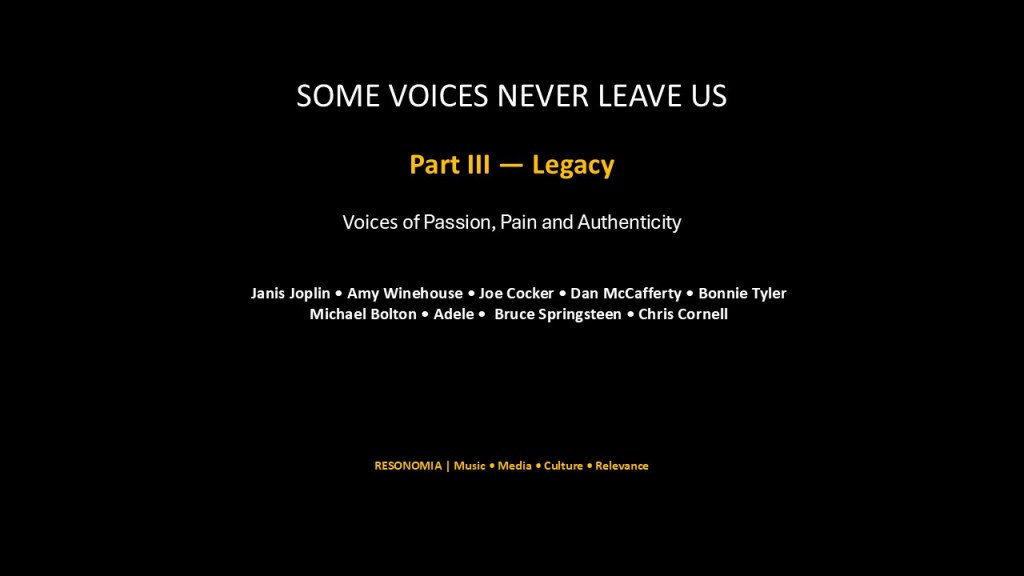
Voices of Passion, Pain and Authenticity
Some voices impress us. Others astonish us.
And then there are the rare voices that seem incapable of hiding who they truly are.
They do not simply sing.
They confess.
They celebrate.
They ache.
They comfort.
Sometimes they even seem to fall apart before our ears.
Yet it is often those very voices that remain with us the longest.
History has never remembered only the most technically perfect singers. We remember honesty, perhaps because music has never really been about perfection.
It has always been about truth.
There are artists whose voices feel less like performances and more like conversations. Listening to them is like hearing a lifetime compressed into a few unforgettable minutes. Every breath, every crack, every hesitation and every soaring phrase becomes part of the story being told.
And somehow, in telling their own stories, these artists end up telling a little of ours as well.
Janis Joplin embodied that honesty with fearless intensity. Nothing in her voice felt guarded or restrained. Joy, loneliness, hunger and heartbreak arrived together, carried by a sound that seemed to come from somewhere far deeper than technique.
Amy Winehouse possessed the same gift for emotional exposure. Her phrasing could sound effortless, but the emotions beneath it rarely did. Wit, defiance, tenderness and pain lived side by side in her voice, reminding us that vulnerability often leaves a deeper mark than perfection ever could.
Joe Cocker surrendered completely to every performance. He did not merely interpret a song. He seemed to enter it physically and emotionally, allowing every phrase to pass through him before reaching the listener. The roughness in his voice was inseparable from its humanity.
Dan McCafferty of Nazareth possessed what might be called a complete voice—strength without sacrificing tenderness, power without losing vulnerability, and a distinctive rasp that always sounded lived rather than manufactured.
Bonnie Tyler transformed what many might have considered an imperfection into her greatest signature. The grain and roughness of her voice became part of its emotional language, proving that what makes a voice unforgettable is often the very quality that prevents it from sounding conventionally flawless.
Michael Bolton showed that sincerity can be every bit as compelling as vocal power. Beneath the scale and force of his performances was an openness that allowed the emotion of a song to remain visible.
Adele continues that tradition today. Her voice possesses undeniable strength, but its lasting impact comes from the emotional openness she allows to remain within it—the breath, the ache, the hesitation and the sense that the emotion has not been polished away.
Bruce Springsteen reminds us that authenticity can matter more than perfection. His voice carries working lives, longing, endurance and hard-earned hope—not polished distance, but lived truth.
And then there is Chris Cornell.
His extraordinary range was only part of what made his voice unforgettable. Power and fragility could coexist within a single line. Darkness, longing, beauty and vulnerability were never separate qualities in his singing; they seemed to emerge together.
Whether surrounded by the force of Soundgarden and Audioslave or standing alone with an acoustic guitar, Cornell never appeared to hide behind the music. His voice revealed too much for that.
Perhaps this is why it continues to resonate. It did not merely demonstrate what a voice could do. It revealed what a person could carry.
Different generations. Different genres. Different lives.
Yet every one of these artists reveals the same lesson: the voices we carry with us are rarely the ones striving to sound flawless. They are the ones that remind us what it means to be human.
Their legacy does not rest only in recordings, awards or technical achievement. It lives in the emotions they made audible, in the moments when someone listening felt understood, and in the recognition that strength and vulnerability are not opposites, but often part of the same truth.
Long after fashions change, recordings age and trends disappear, we remember something much deeper than notes.
We remember how a voice made us feel.
Some voices never leave us.
Because they never stopped telling the truth.
Some Voices Never Leave Us — Part III: Legacy
More voices. More stories. More reflections to come.
RESONOMIA | Music • Media • Culture • Relevance
Exploring the voices, ideas and stories that continue to resonate long after the moment has passed.
 Resonomia
Join the Resonance where ideas resonate and conversations begin. Resonomia explores the intersections of music, media, culture and society, seeking not merely to understand what we experience, but why it continues to resonate. Whether you agree, disagree, or simply wish to share a different perspective, your voice is always welcome. Share your thoughts, questions, and reflections. Every conversation adds another layer to the story.