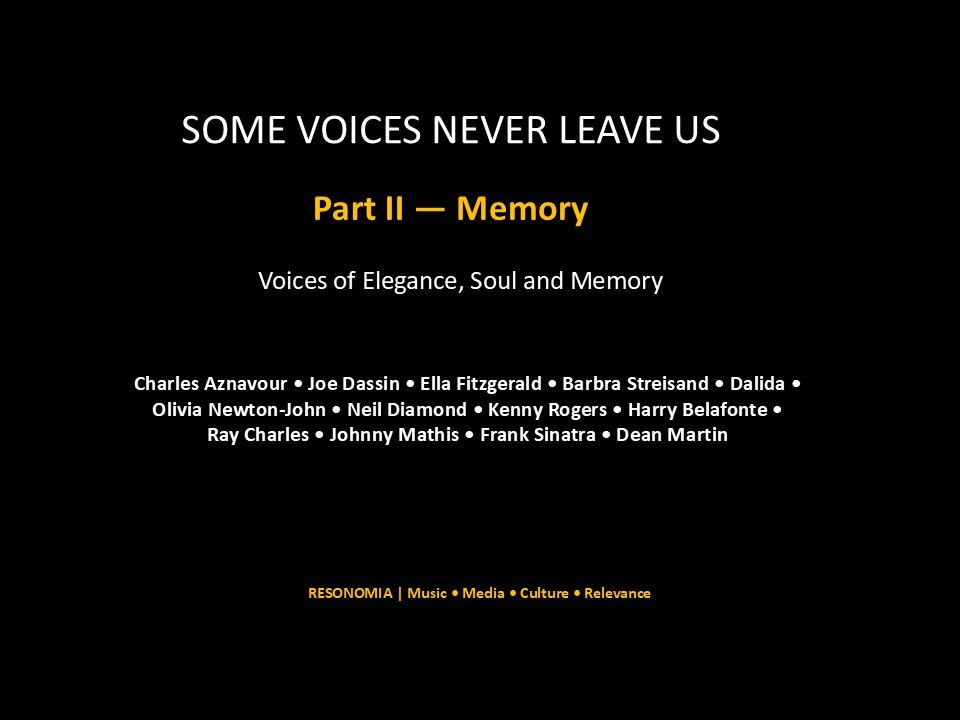
Voices of Soul, Elegance and Memory
Before rock music entered my life, there were other voices.
Voices that arrived not through headphones, playlists or concert stages, but through the ordinary rhythms of everyday life.
They came from record players and tape recorders.
From living rooms and kitchens.
From open windows and family gatherings.
They were the voices that filled the world before I discovered the music that would later become my first great love.
And perhaps because they came first, they never truly left.
When people speak about musical influence, they often focus on genres.
Rock.
Jazz.
Country.
Pop.
Classical.
But memory does not organize itself that way.
Memory remembers people.
Voices.
Moments.
Feelings.
And some voices seem uniquely capable of carrying all of them.
Charles Aznavour’s voice seemed to carry time within it. He did not simply sing about love, regret, loneliness or passing years. He made them feel lived. There was something intimate in his phrasing, as though every song had emerged from a particular room, a particular street or a particular moment that could never be recovered. Listening to Aznavour feels less like hearing a performance than opening a door into someone else’s memory.
Joe Dassin offered a different kind of intimacy. His voice carried an effortless elegance, as though every song were part conversation and part invitation. With Dassin, the distance between singer and listener seemed to disappear. The song became a shared moment.
Ella Fitzgerald brought something different: grace. Her voice seemed to float effortlessly, combining technical mastery with warmth and humanity. Few artists have ever made excellence sound so natural.
Barbra Streisand demonstrated the power of interpretation. Her remarkable voice was matched by an extraordinary ability to inhabit a song completely. Streisand seems to understand every word she sings, then invites the listener into that understanding.
Dalida carried a unique emotional presence. Singing across languages, she made listeners feel as though they had been admitted into something private. Her voice seemed to carry strength and vulnerability at the same time, leaving an impression that endured long after the music ended.
Olivia Newton-John brought gentleness without fragility. There was a clarity and tenderness in her voice that made it immediately comforting. Whether singing something joyful, romantic or quietly reflective, she created a feeling of warmth that never seemed forced. Some voices remind us of specific songs. Others seem to remind us of entire periods of our lives. Hers could do both.
Neil Diamond created another kind of connection. His voice combined warmth, conviction and familiarity in a way that made listeners feel instantly at home. Whether performing intimate ballads or anthems sung by entire arenas, he possessed a rare ability to connect directly with people. Like the other voices in this collection, he never needed to imitate anyone else. He sounded unmistakably like Neil Diamond.
Kenny Rogers understood the quiet power of storytelling. His voice carried warmth, experience and an almost conversational honesty. He could make a song feel less like a story being performed and more like something being shared across a table. There was familiarity in his sound. The kind that made listeners feel they already knew the person speaking—even when they had only just begun to listen.
Other voices carried their own kind of elegance.
Harry Belafonte.
Ray Charles.
Johnny Mathis.
Frank Sinatra.
Dean Martin.
Each possessed something increasingly rare in today’s world: a distinctive musical identity. Not manufactured. Not calculated. Earned.
They sounded like themselves. And that was enough.
What unites these artists is not a genre, a generation or a style. It is something more difficult to define: a quality of presence, the feeling that behind every note stands a complete human being. Not merely a performer. A person.
Perhaps that is why these voices endure. They remind us that music is not simply about sound, but about connection, memory, emotion and the invisible threads that link one generation to another.
Long before rock music captured my imagination, these voices were already teaching me something important: that elegance can be powerful, that sincerity can be unforgettable and that sometimes the most understated voices leave the deepest echoes.
Years later, I still hear them—not only through speakers and recordings, but in memory itself. And that, perhaps, is the truest measure of resonance.
Some voices never really leave us.
They simply become part of who we are.
Some Voices Never Leave Us — Part II: Memory
More voices. More stories. More reflections to come.
RESONOMIA | Music • Media • Culture • Relevance
Exploring the voices, ideas and stories that continue to resonate long after the moment has passed.
 Resonomia
Join the Resonance where ideas resonate and conversations begin. Resonomia explores the intersections of music, media, culture and society, seeking not merely to understand what we experience, but why it continues to resonate. Whether you agree, disagree, or simply wish to share a different perspective, your voice is always welcome. Share your thoughts, questions, and reflections. Every conversation adds another layer to the story.