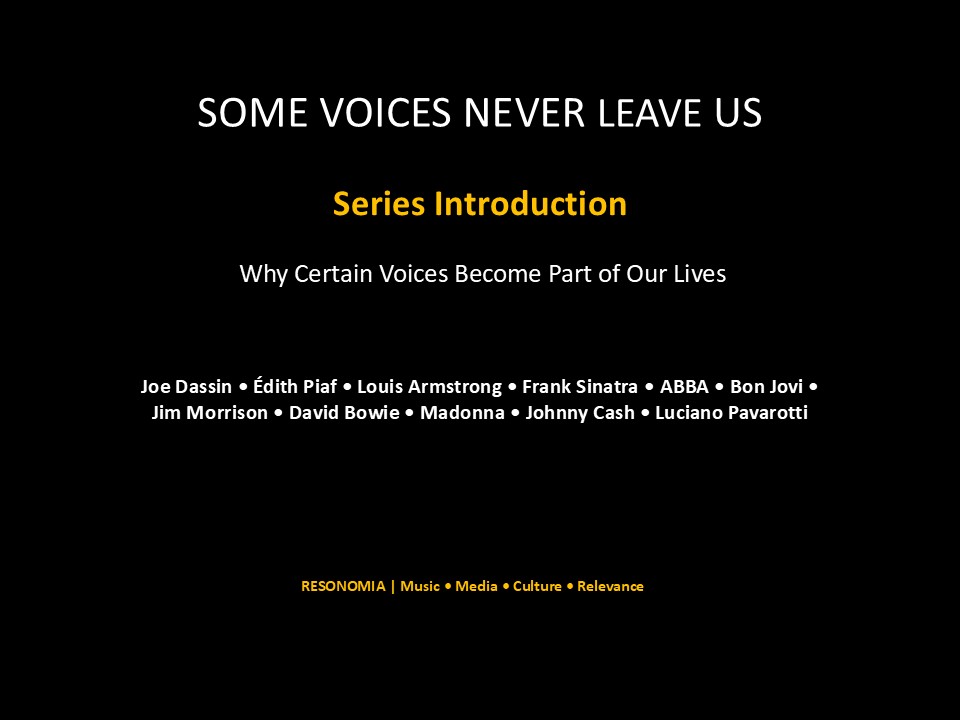
Why Certain Voices Become Part of Our Lives
When we talk about music, we often talk about success.
Albums sold.
Awards won.
Concerts attended.
Chart positions.
Streaming numbers.
Yet none of these things fully explains why certain artists stay with us long after their moment has passed.
Most successful songs eventually fade. Most popular artists gradually become memories.
But some voices seem to follow us throughout our lives.
We hear them unexpectedly—in a supermarket, on the radio, at a wedding, in a café or from a passing car—and recognize them within seconds.
Not because we are trying to.
Because they have become part of us.
Part of our memory.
Part of our personal soundtrack.
Part of our cultural landscape.
That is no small achievement.
History is filled with talented singers. Many possessed exceptional voices and enjoyed immense success. Yet only a handful achieved something rarer.
They became unmistakable.
A few notes are enough.
A single phrase.
A familiar tone.
And instantly we know.
Louis Armstrong.
Édith Piaf.
Frank Sinatra.
Joe Dassin.
Jim Morrison.
David Bowie.
Madonna.
Johnny Cash.
Willie Nelson.
Sting.
Pavarotti.
ABBA.
Bon Jovi.
The list is different for each of us, yet the phenomenon remains the same.
Some voices stay.
Why?
Perhaps because they become attached to moments in our lives.
A first love.
A long drive.
A family gathering.
A difficult year.
A season we never forgot.
Music has an extraordinary ability to preserve emotion, and certain voices become inseparable from the memories they accompany.
But memory alone is not enough. Many artists are associated with particular periods of our lives and still fade away.
The voices that endure possess something more.
Identity.
Authenticity.
Recognizability.
They sound like no one else.
We do not confuse Louis Armstrong with another jazz singer. We do not mistake Jim Morrison for another rock frontman. We do not hear a few seconds of ABBA, Queen or Bon Jovi and wonder who it might be.
Their voices—and sometimes their entire musical identity—are unmistakably their own.
In a world increasingly filled with noise, individuality remains unforgettable.
What is particularly striking is the way these artists transcend generations. Teenagers discover musicians who were already legends before they were born. Songs continue to travel across decades, cultures and languages. A voice recorded fifty years ago finds a new audience and begins another life.
That is not simply popularity.
That is resonance.
And perhaps resonance is what truly matters.
Not whether an artist was fashionable.
Not whether critics approved.
Not whether they dominated the charts.
But whether the voice continues to mean something to people long after the moment has passed.
This series is dedicated to those voices.
The ones that became part of our lives.
The ones we recognize within seconds.
The ones that continue to resonate across generations.
The ones that never really leave us.
Because some voices do more than fill the air.
They become memories.
They become companions.
They become part of who we are.
And long after the music ends, they remain.
Some Voices Never Leave Us — A Resonomia Series on Music, Memory and Resonance
More voices. More stories. More reflections to come.
RESONOMIA | Music • Media • Culture • Relevance
Exploring the voices, ideas and stories that continue to resonate long after the moment has passed.
 Resonomia
Join the Resonance where ideas resonate and conversations begin. Resonomia explores the intersections of music, media, culture and society, seeking not merely to understand what we experience, but why it continues to resonate. Whether you agree, disagree, or simply wish to share a different perspective, your voice is always welcome. Share your thoughts, questions, and reflections. Every conversation adds another layer to the story.